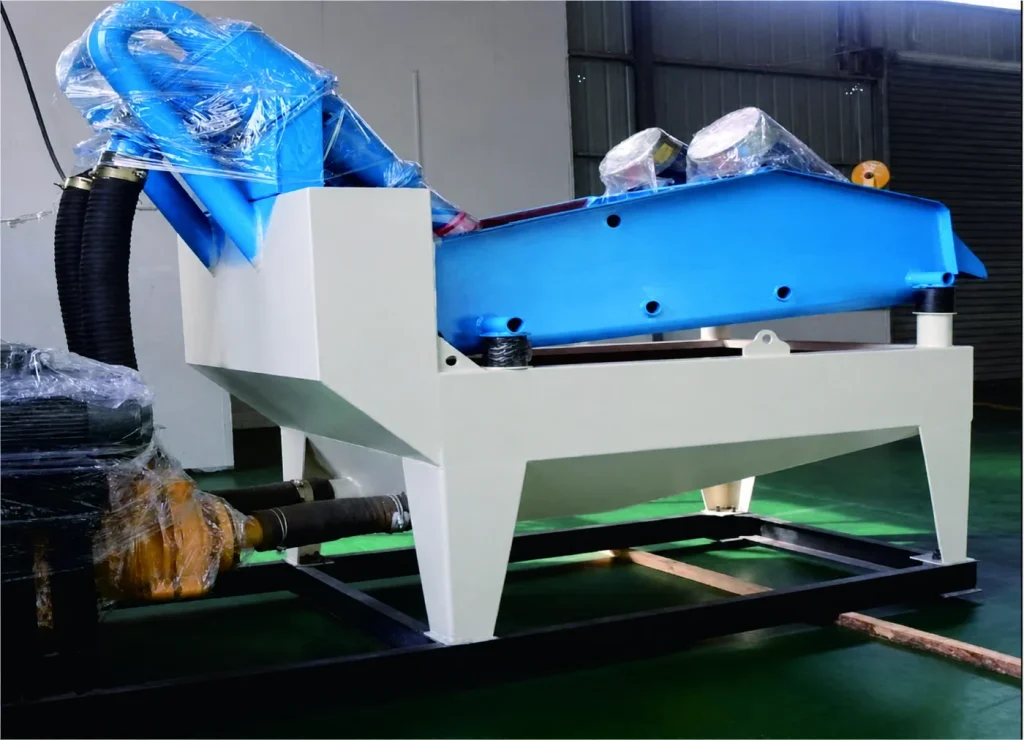
Recover fine particles from a wash-water stream
A pump, cyclone and dewatering screen recover fine particles from wash water. Water flow, solids concentration and target grading guide selection.
Describe the incoming stream and the recovered material needed. The catalogue combines a pump, cyclone and dewatering screen, with model selection guided by water flow, solids concentration and grading.
Applications to discuss
- Sand-washing effluent
- Fine sand recovery
- Tailings classification
Models and reference specifications
| Model | Vibration Motor Power (kW) | Water‑handling Capacity (m³/h) | Weight (t) | Screen Size (mm) |
|---|---|---|---|---|
| WS0820 | 0.75×2 | 30-60 | 1.8 | 800×2000 |
| WS1020 | 1.1×2 | 80-100 | 2.5 | 1000×2000 |
| WS1230 | 1.5×2 | 150-200 | 3.0 | 1200×3000 |
| WS1830 | 2.2×2 | 150-200 | 4.0 | 1800×3000 |
| WS2036 | 3.0×2 | 220-320 | 5.8 | 2000×3600 |
| 2WS2440 | 3.7×2 | 350-450 | 8.5 | 2400×4000 |
The source lists reference water-handling capacity in m³/h, not recovered dry sand in t/h or fresh-water consumption. Duty depends on feed slurry concentration and particle size. The power column covers vibration motors only; the slurry pump is selected separately. The source identifies 2WS as the twin-cyclone configuration.
Inputs for recovery-unit selection
| Selection input | What to provide |
|---|---|
| Water flow | Normal and peak feed-stream flow in m³/h. |
| Solids in the stream | Solids concentration and particle-size distribution, with available sample or test data. |
| Recovery target | The grading to recover and the downstream handling requirement. |
| Existing wash circuit | The source of the feed stream, available space and water-return route. |
Define the supply scope
Clarify whether the task is a recovery-unit addition, a replacement, or a complete sand-washing upgrade. Define the feed-stream connection, recovered-sand discharge and overflow route within the existing or proposed line.
Send the material and operating requirements for this equipment.